 Intensifiers are the most overused words on the planet. These awesome and terrific tips are a wonderful way for real writers to write their absolute magnificent best.
The underlined words are just a few intensifiers. Now the sentence without them: These tips are a way for writers to write their best. Uncluttered, and frankly, much less ridiculous.
We all want our words to make an impact, but that should be done with impactful writing, not flooding our manuscripts with verbiage that done add anything by clutter.
Consider this example: “She is completely naked.” Does saying “completely naked,” give the reader a different image than that of “She is naked?” No.
Sometimes intensifiers have the opposite effect than intended. Instead of a crisp statement, you have something heavy, with no impact, for example: “I am totally angry.” If sounds like a teenage girl trying to express herself. Not as effective as “I am angry.”
Authors often complain about their editor’s penchant for flagging adverbs. Much of the bad rep that adverbs have is because of the empty use of intensifiers. Strengthen your sentences, use more effective adverbs, and you will find that intensifiers become a thing of the past.
Stephen King writes in On Writing: A Memoir on the Craft: “Adverbs, like the passive voice, seem to have been created with the timid writer in mind.”
In reading, writing, and editing, I’ve observed a universal love affair with intensifiers. Very, enough, extremely, strongly, really, only, too, fairly, quite, rather, pretty, so, absolutely, never, always, little, completely, totally, utterly, exceptionally, incredibly, amazingly, remarkably, unusually, particularly, and on and on, ad infinitum.
Adjectives have their place- While this is true, the best alternative is to structure your sentences with stronger verbs, adjectives, and other adverbs.
We use intensifiers to indicate force – The fire is extremely hot. In truth, fire is hot. Readers understand fire. The use of extremely doesn’t make it hotter. It conveys nothing at all if you analyze the sentence. In fact, when stories are clogged with such attempts to intensify words that alone are intense, they reduce the intended meaning and often sound silly. They also slow down the reading.
Now, I will take a moment to defend this position. Speak your sentence aloud, and I guarantee, 99% of the time, they will sound less intense and needlessly wordy.
Here are more examples, courtesy of Daily Writing Tips, of intensifiers that we should avoid. In each case, note the original meaning of each word, and how that meaning has become skewed.
1. Absolute: The original sense of absolute is “ultimate,” but now it is weakly used as an intensifier.
2. Awesome: Originally, something awesome inspired awe. Now, the most mundane phenomena are exalted as such.
3. Fabulous: This adjective, derived from fable, once referred to sensory stimuli one might expect to encounter in a flight of fancy, but users have appropriated it to describe extravagant fashion sense or, more mundanely, notable accomplishments, but it is most potent when restricted to describing phantasmagorical phenomena.
4. Fantastic: Avoid using as a synonym for excellent; senses such as “unbelievable,” “enormous,” and “eccentric” are truer to the source.
5. Incredible: As with fantastic, usage of this word has strayed far from the original meaning of something that does not seem possible. Only if a story literally cannot be believed is it authentically incredible. (Three intensifiers in one sentence!)
6. Magnificent: Something magnificent was originally grand or sumptuous, exalted or sublime, but over time, we have diminished the word’s impact in response to merely commendable achievements. Reserve usage to describe things of stunning impact.
7. Real: This term derives from the Latin term res, “thing, fact,” and should be used only to denote genuine, actual, extant, practical phenomena; minimize its use, and that of the adverb really, as a synonym for complete or completely.
8. Terrific: Terrific, originally referred to something terrifying, however the meaning has long been rendered impotent by use as a synonym for great. Try to reserve it for such descriptions as “a terrific crash.”
9. Wonderful: Use when a sense of wonder is involved, or at least when there is an element of surprise, not just to suggestion a reaction of delight.
10. Very: The most abused word on this list — and one of the most in the entire English language — comes from the Latin word for “true.” Consider restraining yourself from using it in writing except to convey verity, precision, and other adjectival connotations, rather than the adverbial sense of “exceedingly.”
Mark Twain said it best: “Substitute ‘damn’ every time you’re inclined to write ‘very.’ Your editor will delete it and the writing will be just as it should be.”
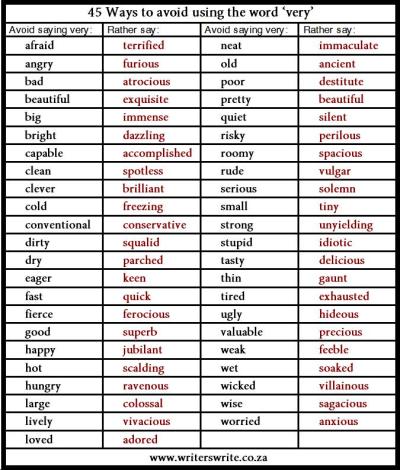
The words “very” or “really” (or truthfully any intensifier) are just another way of increasing the value of a word without adding anything descriptive. You’re also using two words when one would suffice, and unless you’re getting paid by the word, it’s best to avoid. Instead of saying “very loud,” use “deafening,” “thunderous,” or “piercing.” Not only do they roughly mean the same as “very loud,” but they are much more descriptive.
Examples of intensifiers:
I strongly disagree.
The weather is extremely hot in Africa.
You play soccer very well.
Do you really mean it?
That book is fairly interesting.
The atmosphere is quite calm here.
He’s pretty intelligent.
These students are rather noisy.
I so wanted to buy the dress.
She writes poems too often.
I am a little angry with her.
Strong adjectives to use in place of very:
enormous, huge = very big
tiny = very small
brilliant = very clever
awful; terrible; disgusting; dreadful = very bad
certain = very sure
excellent; perfect; ideal; wonderful; splendid = very good
delicious = very tasty
We do not normally use very with these adjectives. We do not say something is “very enormous” or someone is “very brilliant”.
With strong adjectives, we normally use intensifiers like:
The film was absolutely awful.
He was an exceptionally brilliant child.
The food smelled really disgusting.
Eliminate absolutely, exceptionally, and really. The sentences will stand on their own.
Below are two of my pet peeves in writing. I’ve read stories where these two words, suddenly/sudden and started/began were used so frequently, that I came to see myself at the literary equivalent of a tennis match.
Sudden/suddenly are useless. They tell the reader what the author wants to convey, instead of showing. Write the action and forget these words. As Anton Chekhov said. “Don’t tell me the moon is shining, show me the glint of light on broken glass.”
The same applies to quickly. Show us a strong, active sentence, and you won’t need this crutch word.
Start/Started
“He started reading.” “She started singing.” “They started talking.” These sentences are passive and clunky. They slow down the reading. Revise to read, “He read.” “She sang.” “They talked,” and you have better phrased, active sentences.
Every action starts. Embellish on the action if need be: “He read the book from start to finish.” “She sang for hours.” “They talked all night long.” Each sentence provides a better scope of time than using the word “started”.
Use started when there is a definite starting time – “The race started at eight this morning.”
While there are appropriate times to use these words and their variations, it is best to avoid them and give your sentences more active treatment. Strengthen your sentences, show, don’t tell, and create active and not passive paragraphs, and you will see these intensifiers disappear you’re your writing.
A note about Language Evolution
The argument that language evolves doesn’t wash. Words mean what they mean, and simply because we use them incorrectly (yes, I do too,) doesn’t mean that the “new” meaning negates the original meaning. “Sick” doesn’t mean great and “bad” doesn’t mean good.
Yes, language evolves, but when it takes such drastic detours, someone has to stay “enough.” Not all change is good change.
For more information and helpful links, aside from the ones above, try these places on the web.
Very and other useless words to erase forever
Get a useful PDF list of intensifiers.
Adjective Intensifiers
Next month we will talk about disembodied body parts. Oh, those traveling eyes!
 Author Bio: Born in a small town in Upstate New York, Brita Addams has made her home in the sultry south for many years. In the Frog Capital of the World, Brita shares her home with her real-life hero—her husband, and a fat cat named Stormee. All their children are grown.
Given her love of history, Brita writes both het and gay historical romance. Many of her historicals have appeared on category bestseller lists at various online retailers.
Tarnished Gold, the first in her Tarnished series for Dreamspinner, was a winner in the 2013 Rainbow Awards, Historical Romance category. It also received nominations, from the readers of the Goodreads MM Romance Group, for Best Historical and Best Book of 2013.
Brita and her husband love to travel. They’ve taken no less than twenty-five cruises and countless long car trips, as well as completed a Civil War battlefield tour, and visits to many sites involved in the American Revolutionary War. Their 2013 anniversary tour of England, Scotland, and Wales gave Brita fodder for many new tales.
On a trip to Hollywood, California, at Grauman’s Chinese Theater, Brita stood in the footprints of some of her favorite actors—Clark Gable, Henry Fonda, Tyrone Power, and many others. She has even kissed Mickey Rooney, God rest his precious soul.
A bit of trivia—Brita pronounces her name, Bree-ta, and not Brit-a, like the famous water filter. Brita Addams is a mash-up of her real middle name and her husband’s middle name, with an additional d and s.
Insert ATRIH LogoOn the last Tuesday of each month, at 2 pm Central time, 3 pm Eastern, Brita hosts a Blog Talk Radio show for Writers Online Network, entitled And the Rest is History, where she interviews authors, and sometimes publishers and readers of historical fiction.
On May 27, Brita interviews Kirsten Blacketer, author of An Irresistible Shadow for Breathless Press. This book has a great concept, and I’m looking forward to talking to Kirsten about it.
Watch Facebook and Twitter for all the details.
Here is WON Radio’s interview with Brita.
Contact Links:
Website/Blog
Twitter: @britaaddams
Facebook
Fan page
Pinterest
Booklikes
Dreamspinner author page
Monthly column at The Novel Approach
Writer’s Online Network/Blog Talk Radio

 The Novel Approach Reviews
Hey, Brita, I’m running out of room for my “Brita Writing” bookmarks. Another great post. I’m sharing. Hugs and keep up these great writer posts. <3
LikeLiked by 1 person
Another great post – my breath is bated for dropping eyes and wandering hands!!
LikeLiked by 1 person
Hi Paul and Suze,
I’m continually amazed at the different things we can do to make our writing better. I thought of another intensifier that I don’t think I included – a bit. Good night, Irene, I have used that one overmuch.
Next month is a fun one – disembodied body parts. Suze, I have dropping eyes and wandering hands, just for you
Hugs to you both, and to my LIsa, of course.
B.
LikeLiked by 1 person
Love and hugs to you too, Brita. <3
LikeLiked by 1 person
Fantastic post! I love seeing all the little ways writing can be improved spelled out like this.
LikeLike
Thank you Penny. I’m with you. I love the idea that we can constantly improve. Thanks for stopping by!
LikeLike
This is a keeper. We may know these things, but we fall into the “easy” pit and break the rules, often becoming redundant.
LikeLike
Hi Mary. Thank you! Redundancy is a pit unto itself. I’m always looking for new ways to say things. Thank you for stopping by.
LikeLike
This is excellent! Well worth my time to read through completely!
LikeLiked by 1 person
Thank you Julie. I’m pleased you find it useful. Thanks for coming by.
LikeLike
Some excellent points here, and your layout is superb.
LikeLiked by 1 person
Thank you Vonnie.
LikeLike
Thank you I will start tomorrow by pruning my drafts ;)
LikeLiked by 1 person
Pruning is always a good thing. I’m working on an older manuscript and am doing the same thing. I’ve learned a lot over the years. :)
LikeLike
Reblogged this on Sandra Bennett – Author and commented:
A brilliant article to not only make us think about the way we use words but help improve our daily writing whether that is for publication or not. Great suggestions for teachers also to help students learn the craft of writing. Wise words worth sharing.
LikeLiked by 1 person
Thank you so much Sandra. I’m honored.
LikeLike
Good points. Shared on Google+.
LikeLiked by 1 person
Thank you HL. Thanks for coming by.
LikeLike
Great post. Thank you for sharing, Britta.
LikeLiked by 1 person