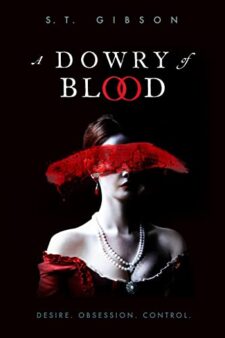
 Title: A Dowry of Blood
Author: S. T. Gibson
Publisher: Redhook/Hachette
Length: 250 Pages
Category: Historical Fantasy, Gothic Horror
Rating: 4.5 Stars
At a Glance: A Dowry of Blood is an homage to Dracula, passionate and evocative with a lushness of prose that heightened the emotions of the story Constanta tells. It’s a sort of confessional poetry, for lack of a better description, and there is a sense that she needed to unburden herself of these memories before she began the next chapter of her immortality.
Reviewed By: Lisa
Blurb: Saved from the brink of death by a mysterious stranger, Constanta is transformed from a medieval peasant into a bride fit for an undying king. But when Dracula draws a cunning aristocrat and a starving artist into his web of passion and deceit, Constanta realizes that her beloved is capable of terrible things. Finding comfort in the arms of her rival consorts, she begins to unravel their husband’s dark secrets.
With the lives of everyone she loves on the line, Constanta will have to choose between her own freedom and her love for her husband. But bonds forged by blood can only be broken by death.

Review: S. T. Gibson’s A Dowry of Blood is not a romance novel. It’s a love letter of sorts. It could also be said it’s a loathe letter at times. It’s a story of survival. It’s a story of obsession, of possession, of control masquerading as love, told in the epistolary form and spanning centuries—from the moment a stranger appears out of the darkness and ruins of a razed village to snatch a young woman from the clutches of certain death, through plague and wars, and on into the 20th century. Through the years, the woman endures, she perseveres. She survives, but she could hardly be said to thrive if we define that in terms of her independence and autonomy. She is known as Constanta in her undeath, and her would-be savior welcomes her into immortality by taking her as his bride. As the narrative unfolds, readers understand that these words, this story, is a purging of Constanta’s memories, if not her soul. And we see she was as much a prisoner as she was a possession.
Constanta detailing the events in her long life is a study in patience, not because it’s uninteresting but because it takes time to reveal the accumulated experiences and thoughts she’s gathered over the centuries. This book rests solely on her capable shoulders and her ability to draw us into her orbit and keep us there. Her sire—Dracula, in case that’s not obvious—collects partners only to become disinterested in them to the point of distraction, and this holds true for Constanta. When her husband introduces her to Magdalena, a beautiful, vibrant, ambitious, intellectually and emotionally exhilarating woman—everything Constanta is not—it creates conflict. Constanta feels her husband’s betrayal at hiding his ongoing correspondence with Magdalena—some might say he’d been grooming her, which is true—and yet Constanta can’t help but be wildly attracted to the Spanish beauty all the same.
Dracula and Constanta welcome Magdalena into immortality and into their marriage, their bond eternally forged, but Magdalena doesn’t find the life she wanted or anticipated, and her light waxes and wanes as the years press on. The passage of years breeds ennui, as one might expect in a vampire’s tale, and eventually, in the search for something to enliven them, they welcome a fourth into their marriage and into their beds, a young man named Alexi who brings something long-missing into their relationship, something apart from being another sexual partner for the three of them. His youth and vibrancy and spirited nature, as well as his tendency towards rebellion, soon grates on his sire, though, with irrevocable consequences, which eventually pits Alexi, Constanta, and Magdalena against their maker. The shift in tone, from restrained, somber, to suspenseful and life-altering is dramatic while, at the same time, a bit sorrowful and sentimental when all was said and done.
A Dowry of Blood is an homage to Dracula, passionate and evocative with a lushness of prose that heightened the emotions of the story Constanta tells. It’s a sort of confessional poetry, for lack of a better description, and there is a sense that she needed to unburden herself of these memories before she began the next chapter of her immortality. Everything Constanta felt, every thought she had, but hid as best she could for fear of the consequences, is revealed in her story.

You can buy A Dowry of Blood here:
[zilla_button url=”https://www.hachettebookgroup.com/titles/s-t-gibson/a-dowry-of-blood/9780316501286/” style=”black” size=”large” type=”round” target=”_blank”] Redhook/Hachette [/zilla_button][zilla_button url=”https://books2read.com/A-Dowry-of-Blood” style=”black” size=”large” type=”round” target=”_blank”] Amazon/Kindle Unlimited [/zilla_button]

 The Novel Approach Reviews